Why Improving Guitar Skills Makes You Feel More Behind
Published:
Sometimes, the more you practice guitar, the more behind you feel.
You’re cleaner than you were a few months ago. You’re faster. You understand more theory. And yet somehow, you’re more dissatisfied than when you started.
This feeling often gets lumped into the Dunning–Kruger effect, which is the idea that beginners overestimate their ability and intermediates underestimate it. But that’s not the full story.
There’s another force at play: the Taste Gap, a term popularized by Ira Glass when describing the creative process.
The Taste Gap Explained
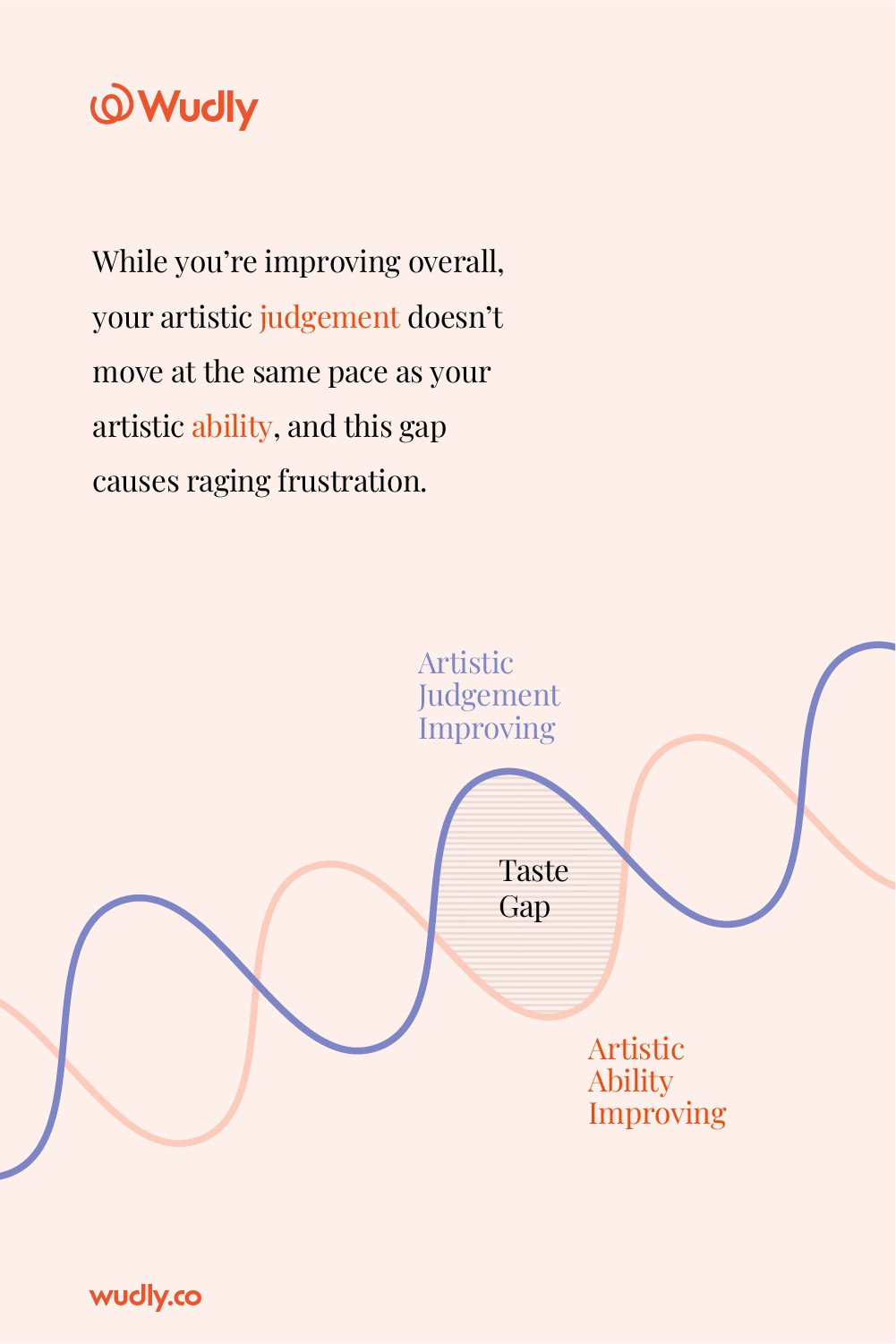
In short, the Taste Gap is the principle that your ability to judge quality improves faster than your ability to produce it.
The more you practice:
The sharper your ear gets.
The more refined your sense of timing becomes.
The more nuance you hear in tone and articulation.
The more small mistakes become obvious.
Your perception upgrades before your execution fully catches up and the frustration lives in that gap.
What It Looks Like on Guitar
The first time you discover the pentatonic scale, a world opens up. Everything sounds expressive. The hundredth time you play it, it feels repetitive. The thousandth time, you’re hearing mostly flaws. Your bends aren’t perfectly in tune. Your vibrato is uneven. Your timing drifts slightly behind the beat. Your phrasing sounds mechanical instead of intentional.
It feels like you’re sounding worse, but really you’re just hearing better.
The Moving Target Effect
Each improvement unlocks new flaws. When you increase your picking speed, your accuracy feels off. When you clean up your accuracy, your improvisation feels repetitive. When you improve your improvisation, your phrasing sounds dull. Progress eliminates problems, but also reveals new ones.
How To Manage The Taste Gap While Improving Your Guitar Skills
You can run from the gap, but you can’t hide, so your best bet is to learn to manage it.
Don’t compare yourself to those ahead of you – The only person you should be comparing yourself to is your past self.
Track hyper-specific skills – Don’t track your guitar skills as one thing (ie “being good at guitar”). Break it down into specific micro-skills you’re working on. Watch your progress improving a specific lick, chord progression, or song.
Record yourself regularly – You need to provide your brain with proof of progress. This is why we made Wudly, but you can easily create folders in your camera roll and stay organized with your practice clips that way. However you do it, stay consistent so you can see and share your progress regularly.